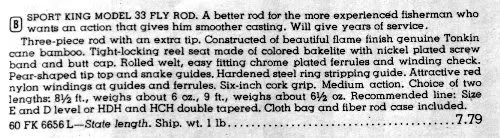
It was most likely made by Horrocks-Ibbotson (H-I) some time between the late 1930’s and mid-1940’s. This rod was in the lower end of their rod line-up
https://classicflyrodforum.com/forum/viewtopic.php?t=44449
https://classicflyrodforum.com/forum/viewtopic.php?p=193960#p193960
Letters were diameters, not weights. Before AFTMA switched to grain weight in 1961, every fly line was braided silk, so a given diameter always weighed about the same and diameter alone was enough. Sizes ran from A (.060″) down to I (.022″) in roughly .005″ steps, matching the logic of leader “X” sizes. Gary Borger
One letter means a level line: that diameter end to end. Three letters means tapered, read as tip / belly / tip. An HDH had a “D” belly of .045″ tapering to “H” tips of .025″; an HCH ran .050″ to .025″. Same first and last letter means double taper. A mismatched last letter (HDG, HCF) was the weight-forward version. Calflyfisher
Modern equivalents, per the standard conversion charts:
- HDH = DT6
- HCH = DT7
- Level E (.040″) ≈ 5wt
- Level D (.045″) ≈ 6wt
Level lines carry full diameter for the whole 30 feet, so they weigh more than a taper with the same belly, which is why rods were often marked “HDH or E” and “HCH or D,” one size thinner for the level line. And silk was noticeably thinner than modern PVC at the same weight, sometimes by 25 percent, so on an old rod plenty of people go a size down from the chart to compensate for the drag of a fatter plastic line.
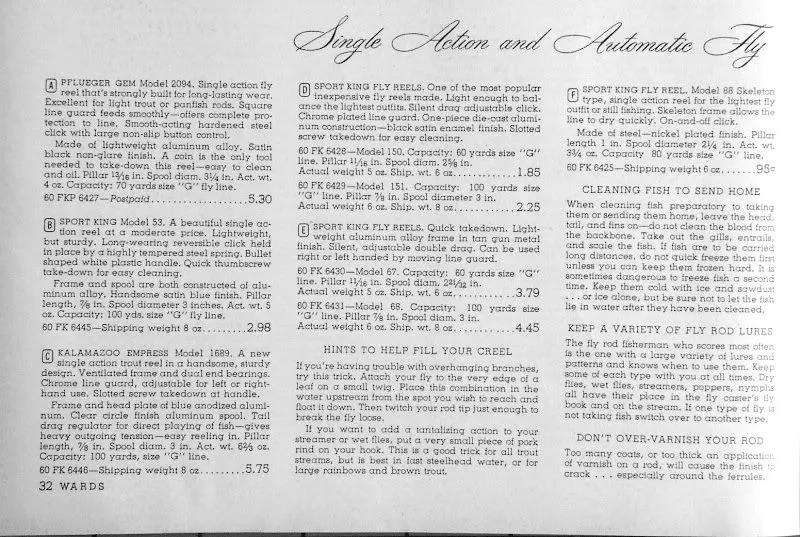
A Sport King Model 151 or Model 68 might be a good match for this rod.